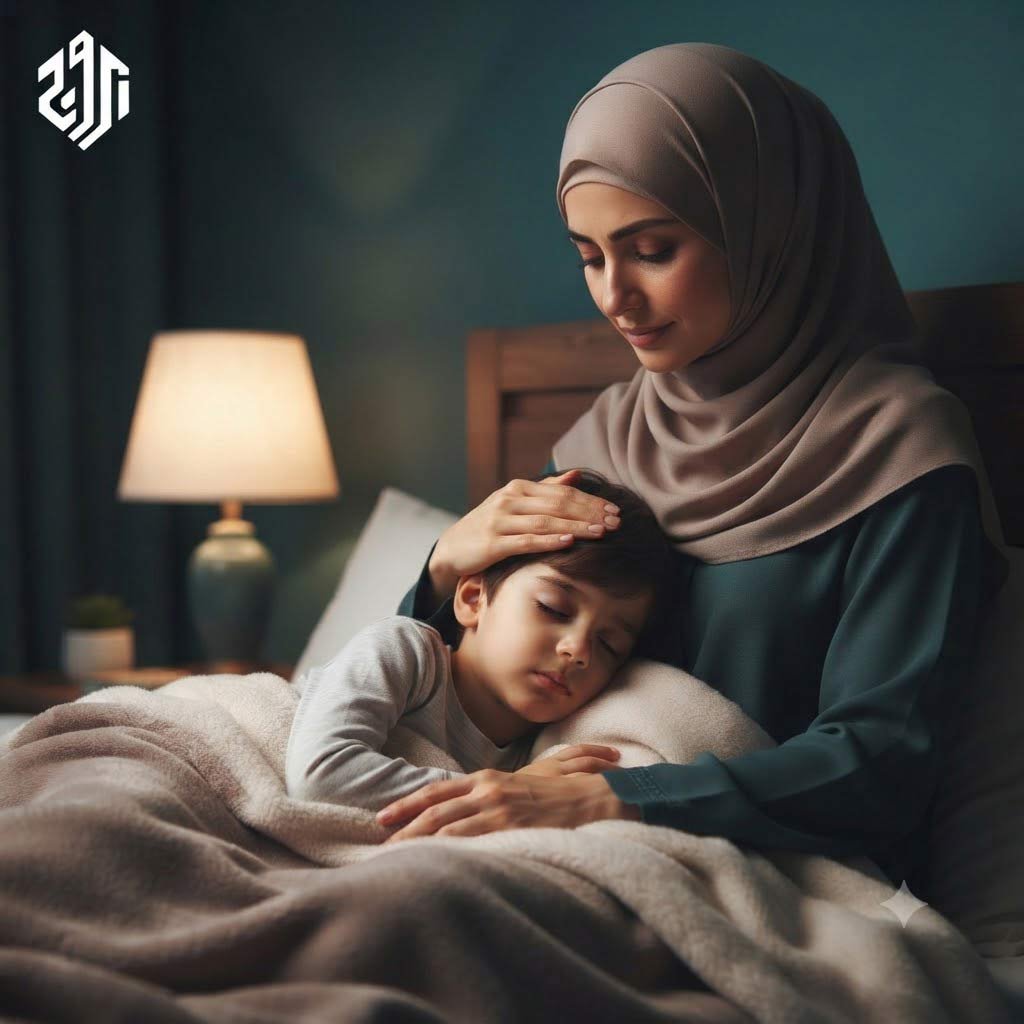
A child’s fever at 2 a.m. brings out a particular kind of helplessness in every parent, Muslim or otherwise. Falaq Academy’s teaching team has sat with parents facing exactly this moment, wanting words that are both true to the Sunnah and gentle enough to whisper over a sleeping child.
Table of Contents:
1. The Prophet’s Own Healing Dua Removes Illness and Calls on Allah as the Healer
This is the single most authenticated healing supplication in the Sunnah, and the one Falaq Academy instructors recommend parents learn first.
‘Aishah (may Allah be pleased with her) reported that whenever the Prophet ﷺ visited a sick member of his household, he would touch them with his right hand while reciting these exact words.
اللَّهُمَّ رَبَّ النَّاسِ أَذْهِبِ الْبَأْسَ اشْفِ أَنْتَ الشَّافِي لَا شِفَاءَ إِلَّا شِفَاؤُكَ شِفَاءً لَا يُغَادِرُ سَقَمًا
Allahumma Rabban-nas, adhhibil-ba’sa, ishfi anta ash-Shafi, la shifa’a illa shifa’uka, shifa’an la yughadiru saqama
“O Allah, Lord of mankind, remove the affliction and grant healing, for You are the Healer. There is no healing except Your healing, a healing that leaves no illness behind.” (Sahih al-Bukhari 5675)
This dua directly names Allah as Ash-Shafi, the Healer, denying that any medicine cures independently of His permission.
To recite it correctly, place your right hand gently on your child’s forehead or the area of discomfort, exactly as ‘Aishah described the Prophet ﷺ doing. Say it once with full presence, or repeat it several times if your child’s condition is causing you distress.
In our sessions with parents preparing to teach their children basic Islamic practices, we’ve noticed that reciting this dua slowly, syllable by syllable, near a child who is old enough to listen often calms both the parent and the child at once.
This is precisely why building a foundation in Quranic Arabic matters so early. Understanding words like Ash-Shafi (the Healer) and shifa (healing) as they appear across the Quran deepens a family’s connection to every dua they recite.
Falaq Academy’s Online Islamic Studies Classes for Kids introduce children to exactly this kind of foundational vocabulary within its first lessons.
| Element of the Dua | Arabic Term | What It Means |
| Address to Allah | Rabban-nas | Lord of mankind |
| Request | Adhhibil-ba’s | Remove the affliction |
| Divine Name invoked | Ash-Shafi | The Healer |
| Closing certainty | La shifa’a illa shifa’uka | No healing except Yours |
The first session is free in Falaq’s Islamic Studies Classes for Kids
2. Jibreel’s Ruqyah Was Taught to the Prophet When He Himself Fell Ill
This dua carries a distinct weight because it did not originate as general guidance; it was revealed by the Angel Jibreel directly to the Prophet ﷺ during his own illness. Abu Sa’eed Al-Khudri narrated that Jibreel came to the Prophet ﷺ, asked if he felt unwell, and then performed this exact ruqyah over him.
بِاسْمِ اللَّهِ أَرْقِيكَ مِنْ كُلِّ شَيْءٍ يُؤْذِيكَ مِنْ شَرِّ كُلِّ نَفْسٍ أَوْ عَيْنٍ حَاسِدٍ اللَّهُ يَشْفِيكَ بِاسْمِ اللَّهِ أَرْقِيكَ
Bismillahi arqika, min kulli shay’in yu’dhika, min sharri kulli nafsin aw ‘aynin hasidin, Allahu yashfika, bismillahi arqika
“In the name of Allah, I perform ruqyah over you, from everything that harms you, from the evil of every soul or envious eye. May Allah heal you.” (Sahih Muslim, cited in Riyad as-Salihin 908)
How to Recite This Ruqyah Over Your Child Correctly?
Place your right hand gently on the child’s head or the affected area while reciting. Some scholars note it may also be recited while lightly blowing after each repetition, following the broader Sunnah of ruqyah practice.
Repeat it three times if the illness feels serious or persistent, since three repetitions is the pattern seen elsewhere in Prophetic ruqyah practice for illness and pain.
Parents new to reciting Arabic supplications sometimes feel self-conscious about pronunciation, and that hesitation is completely understandable.
Read also: Dua for Child Protection in Arabic
3. Seeking Refuge for Your Child With the Same Words Ibrahim Used for Ismail and Ishaq
Ibn ‘Abbas narrated that the Prophet ﷺ regularly recited this exact protection dua over his own grandsons, Al-Hasan and Al-Husain, and explicitly stated that this was the same dua Ibrahim (peace be upon him) used to protect his sons Ismail and Ishaq.
أُعِيذُكَ بِكَلِمَاتِ اللَّهِ التَّامَّةِ مِنْ كُلِّ شَيْطَانٍ وَهَامَّةٍ وَمِنْ كُلِّ عَيْنٍ لَامَّةٍ
U’idhuka bikalimatillahi at-tammati, min kulli shaytanin wa hammatin, wa min kulli ‘aynin lammah
“I seek refuge for you in the perfect words of Allah, from every devil and every poisonous creature, and from every harmful, envious eye.” (Sahih al-Bukhari 3371)
Use “U’idhuka” for a boy and “U’idhuki” for a girl; for two children together, the Prophet ﷺ used “U’idhukuma.”
This dua is broader than a healing supplication; it is a protection dua that many parents recite nightly regardless of whether a child is currently unwell.
When illness strikes, however, reciting it alongside the healing duas above adds a layer of protection from harm that may be compounding the sickness, such as the evil eye.
We’ve found that parents who introduce this dua to children as young as four or five, framing it as words that “Prophet Ibrahim said for his own children,” create an emotional anchor that makes the Arabic memorable well before the child fully grasps the grammar.
This kind of early emotional connection to Quranic Arabic is exactly what Falaq Academy’s Online Quran Classes for Kids course is built around.
Help your child start learning the Quran with a FREE trial

4. Asking Allah by His Greatest Names Seven Times Is a Distinct Prophetic Practice for Visiting the Sick
Ibn ‘Abbas reported that the Prophet ﷺ specifically taught this dua for anyone visiting a sick person whose time of death has not come, to be repeated exactly seven times in the sick person’s presence. This hadith is graded sahih by the hadith scholar Al-Albani.
أَسْأَلُ اللَّهَ الْعَظِيمَ رَبَّ الْعَرْشِ الْعَظِيمِ أَنْ يَشْفِيَكَ
As’alu Allah al-‘Azim, Rabbal-‘Arshil-‘Azim, an yashfiyaka
“I ask Allah, the Mighty, Lord of the Mighty Throne, to heal you.” (Sunan Abi Dawud 3106)
For a daughter, the closing word changes to “yashfiyaki”; when saying it for yourself over a child too young to hear it directly, you can say “yashfiyaha” for a girl or “yashfiyahu” for a boy.
Why the Number Seven Matters in This Specific Dua
Unlike most duas in the Sunnah where repetition count is left flexible, this hadith specifies seven repetitions explicitly. Scholars generally understand this as following the Prophetic instruction precisely rather than treating the number as merely symbolic.
If a grandparent, aunt, or family friend visits your sick child, teaching them this exact dua and repetition count turns a simple visit into a fulfillment of Sunnah.
Read also:Authentic Duas From Quran and Sunnah for Every Muslim
Discover the Falaq Academy Difference
Step into our virtual classrooms and see how our expert instructors make learning Quran and Arabic intuitive and clear. We focus on overcoming the specific hurdles non-native speakers face, building your confidence and connection with the Quran.
Excel in Your Quranic Studies
Join Falaq Academy and master the Quran with our structured, professional curriculum.
Book Your Free TrialRead also:Preparing to Read the Quran: What to Say First
5. Prophet Ayyub’s Quranic Dua Models Patience Through Prolonged Illness
When a child’s illness drags on for days rather than hours, the Quran itself offers a model in the words of Prophet Ayyub (peace be upon him), whose trial with illness lasted years. His dua, recorded in Surah Al-Anbiya, is short enough for even a young child to memorize alongside a parent.
أَنِّي مَسَّنِيَ الضُّرُّ وَأَنتَ أَرْحَمُ الرَّاحِمِينَ
Annee massaniyad-durru wa anta arhamur-rahimeen
“Indeed, adversity has touched me, and you are the Most Merciful of the merciful.” (Al-Anbiya 21:83)
Teaching a child this verse alongside its context, that Ayyub was tested with illness for an extended period yet never lost trust in Allah, gives the dua emotional depth beyond the words themselves.
Understanding prophetic stories like Ayyub’s helps children connect Quranic Arabic to real emotional experiences rather than treating memorization as an abstract exercise.
Parents pursuing a full memorization pathway that includes verses like this one alongside shorter surahs often benefit from a structured system rather than piecing duas together independently.
Falaq Academy’s Hifz for Kids program builds exactly this kind of progression, layering short Quranic duas before introducing full surahs.
Start your child’s Hifz classes with a FREE session
What Does the Etiquette of Dua Require When Praying for a Sick Child?
Reciting the correct words is only part of a dua’s acceptance; the manner of asking matters according to Islamic scholarship. Facing the Qiblah where practical, maintaining wudu when possible, and reciting with certainty rather than doubt are all part of adab ad-dua (etiquette of supplication) that scholars consistently emphasize.
Perhaps most importantly, pairing dua with actual medical treatment is not a contradiction in Islam but an explicit part of the Sunnah.
The Prophet ﷺ instructed Muslims to seek treatment because Allah created both the illness and its cure. A parent reciting these duas while also taking a feverish child to a doctor is following the Sunnah completely, not compromising it.
Children watching a parent recite dua calmly during their own illness absorb something beyond the words: that turning to Allah during hardship is instinctive, not a last resort.
This modeling is often what carries a family’s Islamic identity forward more than formal lessons do, and it connects directly to keeping Islamic identity strong for kids growing up outside a Muslim-majority country.
Read also: How Dua Is Accepted in Islam
Build Your Family’s Foundation in Authentic Dua and Quranic Arabic with Falaq Academy
Knowing these five duas by heart gives your family a Sunnah-grounded response to illness rooted in the Prophet’s own practice. Falaq Academy helps parents and children go further, building genuine understanding of the Arabic behind every dua rather than memorized sounds alone.
Our Ijazah-certified instructors and Al-Azhar University graduates bring 12+ years of experience teaching non-Arabic speakers globally.
Through the Falaq Method’s context-before-abstraction approach, personalized learning plans, and flexible 1-on-1 scheduling, your child can move from reciting duas by rote to genuinely understanding the words they’re saying.
Book a free trial lesson today and give your family a lasting foundation in authentic Quranic Arabic.
Begin your transformation today by choosing the path that fits your goals:
- Online Arabic Classes (General & Comprehensive)
- Arabic Course for Beginners
- Arabic Alphabet Learning Course
- Online Arabic Classes for Kids
- Arabic Classes for Adults
- Arabic Grammar Course (Nahw & Sarf)
- Intermediate Arabic Course (B1/B2)
- Arabic Speaking Course (Conversational Fluency)
- Arabic Reading Course (Literary Excellence)
- Learn Arabic Writing Course (Calligraphy & Composition)
Ready to speak with confidence? Join the global community at Falaq Academy and book your free placement interview today!
Discover the Falaq Academy Difference
Step into our virtual classrooms and see how our expert instructors make learning Quran and Arabic intuitive and clear. We focus on overcoming the specific hurdles non-native speakers face, building your confidence and connection with the Quran.
Excel in Your Quranic Studies
Join Falaq Academy and master the Quran with our structured, professional curriculum.
Book Your Free TrialConclusion
Illness in a child pulls at something instinctive in every parent, and the Sunnah meets that instinct with words already tested across fourteen centuries. These five duas, verified against Sahih al-Bukhari, Sahih Muslim, and Jami’ At-Tirmidhi, give a family exact prophetic language rather than approximated phrases.
What matters beyond memorization is understanding: knowing why Ash-Shafi is invoked, why Ibrahim’s words for his sons still apply today, why Ayyub’s patience is instructive. That depth turns dua from ritual into genuine conversation with Allah, which is ultimately what every parent whispering over a sick child’s bed is truly seeking.
Frequently Asked Questions About Dua for a Sick Child in Arabic
Can I Recite These Duas in English Instead of Arabic?
Reciting the meaning in English is permissible and Allah understands every language, but the Arabic wording carries the exact Prophetic phrasing scholars have verified. Many parents recite the Arabic first, then explain the meaning to their child afterward in English.
How Many Times Should I Repeat a Healing Dua for My Child?
Only one specific dua in the Sunnah specifies an exact repetition count of seven times. For other duas, three repetitions is a common Prophetic pattern, though reciting once with full sincerity is also sufficient.
Is It Necessary to Have Wudu Before Reciting Dua for a Sick Child?
Wudu is recommended and increases the reward of any dhikr or dua, but it is not a strict requirement for dua to be accepted. In an urgent situation with a sick child, reciting the dua immediately without wudu is entirely acceptable.
Can Someone Other Than the Parent Recite These Duas Over the Child?
Yes, any Muslim visiting a sick child can recite these duas, and the specific “As’alu Allah al-‘Azim” dua was taught explicitly for visitors to the sick, not only parents. Teaching grandparents or family friends this exact wording extends the Sunnah practice of visiting the ill.
Should I Combine Dua With Taking My Child to a Doctor?
Yes, absolutely. The Prophet ﷺ explicitly instructed seeking medical treatment alongside dua, since Allah created both illness and its cure. Dua and medicine work together in Islamic practice rather than replacing one another.