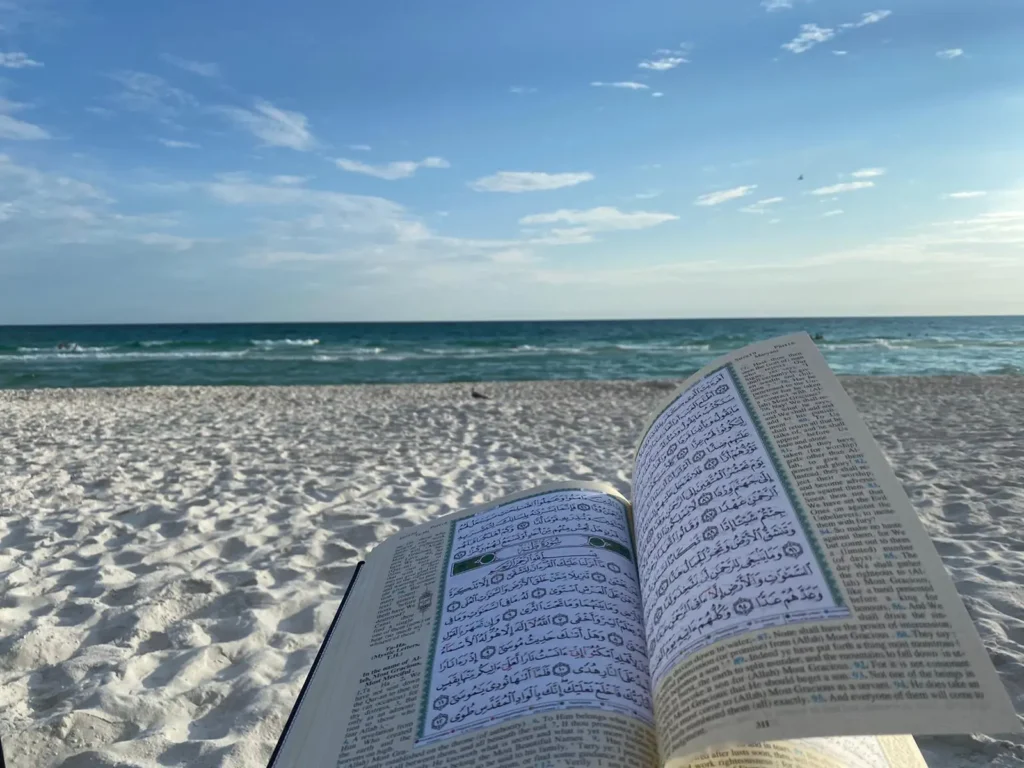
Reading Quran on water is a permissible Islamic practice supported by authentic hadith, the practice of the Companions, and the explicit approval of major classical and contemporary scholars.
Reading Quran on water falls under ruqyah shar’iyyah — Quranic healing — and is valid for physical ailments, spiritual protection, and supplications such as exam success.
Table of Contents:
Is Reading Quran on Water Islamically Permitted?
Reading Quran on water and then drinking or using that water is islamically permitted according to the majority of classical and contemporary scholars. The evidence rests on authentic narrations, the practice of the Salaf (pious predecessors), and the Quranic affirmation that the Quran itself is a healing.
Allah says in the Quran:
وَنُنَزِّلُ مِنَ ٱلْقُرْءَانِ مَا هُوَ شِفَآءٌ وَرَحْمَةٌ لِّلْمُؤْمِنِينَ
Wa nunazzilu minal-Qur’ani ma huwa shifa’un wa rahmatun lil-mu’minin
“And We send down of the Quran that which is healing and mercy for the believers.” (Al-Isra 17:82)
This verse is the foundational evidence. Scholars of Tafsir have consistently held that the Quran’s healing is both spiritual and physical, and that its words carry blessing (barakah) when recited with sincerity and proper intention.
What Did the Prophet ﷺ and His Companions Do Regarding Ruqyah Water?
The practice of reciting Quran over water traces directly to prophetic guidance and the practice of the Companions. This is not a later innovation — it has roots in the earliest generation of Islam.
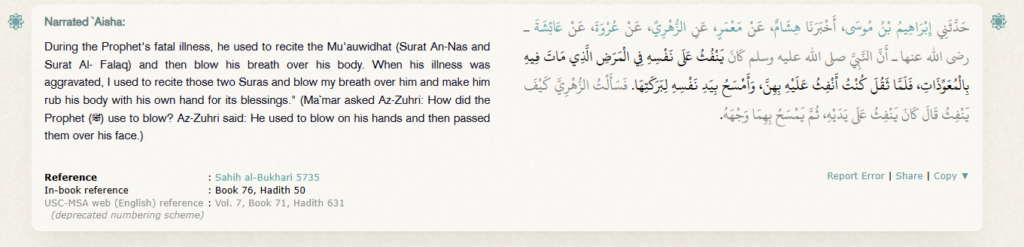
The Prophet ﷺ himself demonstrated healing through Quranic recitation. As recorded in Sahih al-Bukhari 5735, ‘A’ishah (may Allah be pleased with her) reported that when the Prophet ﷺ fell ill, he would recite Al-Mu’awwidhat (Surah Al-Falaq and Surah An-Nas) and blow over himself.
What Did Imam Ahmad ibn Hanbal Recommend Regarding Ruqyah Water?
Imam Ahmad ibn Hanbal’s own practice with water is one of the clearest classical precedents. His son Salih reported that when Imam Ahmad was ill, he would take a cup of water, recite Quran over it, and instruct his family to drink from it and wash their faces and hands with it.
Ibn Mufliḥ recorded this in Al-Adab Al-Shar’iyyah, and it is cited consistently in classical Hanbali fiqh literature as evidence for the permissibility of this practice. His son Abdullah also narrated witnessing his father recite over water and drink from it himself.
What Did Contemporary Scholars Say Regarding Ruqyah Water?
The permissibility of reading Quran on water has been explicitly confirmed by a broad range of major contemporary scholars. These include Sheikh Muhammad ibn Ibrahim Al Sheikh, Sheikh Abdul Aziz ibn Baz, Sheikh Muhammad ibn Salih Al-‘Uthaymin, Sheikh Salih Al-Fawzan, and Sheikh Abdul Aziz Al Sheikh.
| Scholar | Position |
| Sheikh Ibn Baz | Explicitly permitted — water treated with Quranic recitation is valid for healing |
| Sheikh Ibn ‘Uthaymin | Permitted as part of ruqyah shar’iyyah |
| Sheikh Salih Al-Fawzan | Permitted based on Salaf practice and Quranic evidence |
| Sheikh Ibn Jibrin | Confirmed Salaf practice; includes recitation over oil, food, and water |
This level of scholarly consensus across multiple schools of thought removes any serious ambiguity about the ruling.
Read also: Islamic Ruling on Reading the Quran with Shorts On
What Are the Benefits of Drinking Quran Water (Quranic Healing Water)?
The benefits of drinking ruqyah water are not magical or independent of Allah. The water itself holds no intrinsic power. The benefit comes from two sources: the words of Allah carrying His barakah, and the sincere supplication and tawakkul (reliance on Allah) of the person reciting and drinking.
Scholars describe the benefits within three categories:
1. Shifa’ (healing)
Physical ailments, pain, illness, and disease. The Quran is explicitly called shifa’ — and the recitation over water is a means of directing that healing toward a physical medium one consumes.
2. Ruqyah (spiritual protection)
Protection from the evil eye (‘ayn), sihr (magic), and waswasah (whispers of Shaytan). Reciting Al-Mu’awwidhat and Ayat Al-Kursi over water and drinking it is a recognized form of preventative and curative ruqyah.
3. Tawassul for Hajat (supplications for needs)
This includes reciting Quran over water with the intention of asking Allah for success in examinations, relief from anxiety, or ease in difficult matters. As established in classical scholarship, asking Allah through a righteous deed — such as Quranic recitation — is valid tawassul.
At Falaq Academy, our Online Quran Recitation course emphasizes not only correct recitation but also the spiritual dimensions of the Quran — including its role as healing — so students connect with what they are reciting, not just how.
Book your first FREE recitation lesson

How to Perform Ruqyah on Water?
Performing ruqyah on water correctly requires proper intention, authenticated recitations, and awareness that the healing belongs to Allah alone. There is no single prescribed formula — the scholars describe a flexible method rooted in Sunnah.
Read also:Benefits of Surah Al-Hadid: 7 Authentic Virtues
What Should You Recite Over the Water?
The most authenticated recitations for ruqyah water are those reported in Sunnah as being used by the Prophet ﷺ for healing and protection:
| Recitation | Purpose |
| Surah Al-Fatiha | Healing — known as Al-Ruqyah in hadith literature |
| Ayat Al-Kursi (Al-Baqarah 2:255) | Protection from Shaytan and evil eye |
| Al-Baqarah 2:285–286 (last two verses) | Comprehensive protection |
| Surah Al-Ikhlas | Affirming Tawheed, spiritual cleansing |
| Surah Al-Falaq | Protection from external harm and evil eye |
| Surah An-Nas | Protection from waswasah and jinn |
Surah Al-Fatiha deserves special mention. In Sahih al-Bukhari 5736, Abu Sa’id Al-Khudri used Surah Al-Fatiha as a ruqyah, and the Prophet ﷺ confirmed it, saying: “How did you know it is a ruqyah?” — acknowledging its healing function explicitly.
Read also: Benefits of Learning Quranic Arabic
Discover the Falaq Academy Difference
Step into our virtual classrooms and see how our expert instructors make learning Quran and Arabic intuitive and clear. We focus on overcoming the specific hurdles non-native speakers face, building your confidence and connection with the Quran.
Excel in Your Quranic Studies
Join Falaq Academy and master the Quran with our structured, professional curriculum.
Book Your Free TrialWhat Is the Step-by-Step Method for Making Ruqyah Water?
The method described by scholars and grounded in the practice of the Salaf is straightforward:
- Make wudu (ablution) if possible, and face the qiblah with sincerity
- Place clean water in a vessel in front of you
- Recite the selected Quranic verses and supplications with full presence of heart
- Blow lightly (nafth — a gentle breath with minimal moisture) into the water after reciting
- Drink from the water, use it for washing, or give it to the person being treated
- Repeat consistently — scholars note that persistence in ruqyah increases its effect by the permission of Allah
Falaq Academy’s Online Islamic Studies Classes cover ruqyah, supplication etiquette, and Quranic healing in structured lessons taught by Al-Azhar University graduates with over 9 years of Islamic studies training.
Begin Your Islamic Knowledge Journey With a FREE Trial Lesson

Does the Quran Affect Water?
The Quran affects the one who recites it, the one who listens to it, and — by Allah’s permission — the medium through which it is channeled, including water. This is the documented position of mainstream Islamic scholarship supported by textual evidence.
Ibn Al-Qayyim Al-Jawziyyah, in Zad Al-Ma’ad, discussed healing through the Quran at length. He affirmed that the Quran is a complete healer for both heart and body, and that its effect depends on the faith and sincerity of the one using it.
The stronger the iman and the more correct the recitation, the greater the effect — by Allah’s will.
This is why proper recitation matters. In our sessions at Falaq Academy, we consistently observe that students who learn Tajweed alongside ruqyah recitations approach these practices with much greater confidence and spiritual presence.
When a person knows they are pronouncing the words of Allah correctly, their engagement with the recitation deepens meaningfully.
If you want to strengthen your recitation for this purpose, our Tajweed for Beginners course provides a structured foundation built by Ijazah-certified instructors.
Book Your FREE Trial Lesson to Begin Your Tajweed Journey
Is Reading Quran on Water for Exam Success Islamically Valid?
Reading Quran on water with the intention of asking Allah for success in examinations is islamically valid. This falls under tawassul bil-‘amal al-salih — using a righteous deed as a means of supplication to Allah. Scholars confirm that reciting Quran and then asking Allah for worldly or spiritual needs through that recitation is explicitly encouraged in Sunnah.
The hadith narrated by Imran ibn Husayn, recorded in Musnad Ahmad and authenticated by Al-Albani in Sahih Al-Jami’, states that the Prophet ﷺ said:
“Recite the Quran and ask Allah through it, for there will come a people who recite the Quran and ask through it from the people.”
The clear implication is that asking Allah through Quranic recitation is the correct and approved practice.
For exam preparation specifically, one can recite Surah Al-Fatiha, Ayat Al-Kursi, and Al-Mu’awwidhat over water, drink it with sincere dua for clarity, focus, and success — while also taking full practical means (studying, preparing, revising).
Tawakkul is never a replacement for effort. To build a stronger connection with the Quran itself throughout your preparation, our guide on reading the Quran for the first time is a helpful starting point.
Read also: The Best Quranic Arabic Courses
Deepen Your Quranic Practice with Falaq Academy’s Expert Instructors
The Quran is healing, guidance, and mercy — but experiencing its full benefit requires reciting it correctly and understanding what you recite. Falaq Academy’s Online Quran Recitation course and Online Tajweed Classes are taught by Ijazah-certified instructors and Al-Azhar University graduates with 12+ years of experience teaching non-Arabic speakers globally.
- Personalized 1-on-1 sessions with flexible 24/7 scheduling
- The Falaq Method: Sound-before-rules for authentic recitation from day one
- Real-time pronunciation correction and structured progression
- Qualified teachers who understand the spiritual weight of what they teach
Book your free trial lesson today and recite the Quran with the accuracy it deserves.
Take the next step in your learning journey today by enrolling in one of our specialized programs:
- Online Quran Classes
- Online Quran Classes for Beginners
- Online Quran Classes for Adults
- Online Quran Classes for Ladies
- Online Quran Classes for Kids
- Quran Reading Course
- Quran Recitation Course
- Online Ijazah Course
- Online Qirat Course
Don’t wait to transform your relationship with the Holy Quran. Join our global community of students and book your free evaluation session now!
Excel in Your Quranic Studies
Join Falaq Academy and master the Quran with our structured, professional curriculum.
Book Your Free TrialConclusion
Reading Quran on water is a permitted, documented Islamic practice — not a folk tradition or innovation. It is rooted in the Quran’s own declaration as shifa’, confirmed by the prophetic Sunnah, practiced by Imam Ahmad ibn Hanbal, and endorsed by major contemporary scholars across madhabs.
The healing belongs to Allah alone. The recitation is the means, the sincerity is the condition, and the correct pronunciation strengthens both. Whether the purpose is physical healing, spiritual protection, or asking Allah for success in examinations, the practice is valid when approached with proper intention and authentic recitation.
Invest in the quality of your recitation — because every word you direct toward Allah in dua, ruqyah, or worship is worth perfecting.
Frequently Asked Questions About Reading Quran on Water
What Surah Should I Recite for Ruqyah Water?
The most authenticated surahs for ruqyah water are Surah Al-Fatiha, Ayat Al-Kursi, the last two verses of Surah Al-Baqarah, and Al-Mu’awwidhat (Surah Al-Ikhlas, Al-Falaq, and An-Nas). These are directly reported in the Sunnah as recitations the Prophet ﷺ used for protection and healing.
How Many Times Should I Recite Over the Water?
There is no fixed number prescribed in authentic hadith for ruqyah over water. Scholars recommend reciting each surah or verse at least once with full presence of heart, blowing gently into the water after recitation. Some scholars suggest repeating three or seven times based on general ruqyah practice, but this is not strictly mandated.
Can a Woman Perform Ruqyah on Water for Her Family?
Yes. A woman may perform ruqyah on water for herself and her family. There is no scholarly restriction based on gender. The conditions for valid ruqyah apply equally: sincere intention, authentic Quranic recitation, and firm belief that healing comes from Allah alone — not from the person reciting.
Is It Permissible to Recite the Entire Quran (Khatmah) on Water?
Reciting a full khatmah (complete Quran recitation) over water is permitted according to the majority of contemporary scholars, including Sheikh Ibn Baz and Sheikh Ibn ‘Uthaymin. It falls under permissible tawassul through righteous deeds. The person recites the Quran seeking Allah’s blessing and then uses the water for healing or supplication.
Does the Water Need to Be in a Specific Vessel or Quantity?
No specific vessel or quantity is prescribed in authentic Islamic sources for ruqyah water. Clean, pure water in any appropriate container is sufficient. Scholars make no distinction between glass, clay, or metal vessels. The focus is on the sincerity of intention, the correctness of recitation, and reliance on Allah — not on the container used.